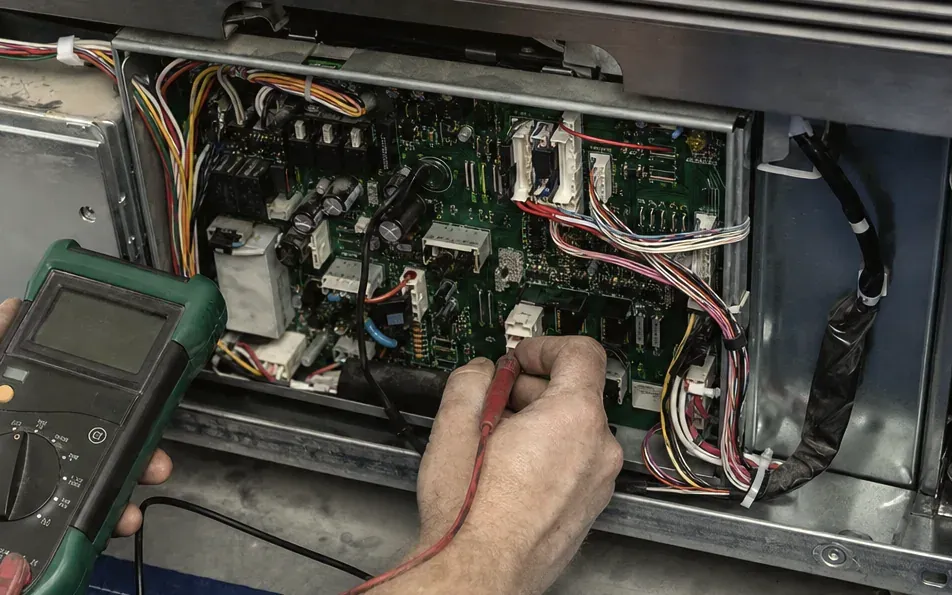
The right Sub-Zero freezer temp is 0°F (-18°C), which is also the default on Classic (CL) and Designer (DET, DEC) controls, with the refrigerator side sitting at 38°F (3°C). The freezer control accepts any setting from -5° to 5°F in one-degree steps, and Sub-Zero asks owners to give the unit 24 hours to settle after a change before judging the result. If your thermometer still shows a reading well above 0°F a full day after you set it, the number on the panel is not the problem, and the rest of this page walks through what usually is.
The correct setting on each Sub-Zero control
Sub-Zero has built several generations of controls, and the adjustable window differs a little between them. The freezer target of 0°F holds across all of them; what changes is how far the fresh-food side can be pushed.
- Classic (CL) and Designer (DET, DEC): refrigerator 34° to 42°F, freezer -5° to 5°F, out of the box at 38°F and 0°F.
- Classic (BI) and Designer (IT, IC, ID): refrigerator 34° to 45°F, freezer -5° to 5°F.
- Designer Undercounter (DEU) freezer drawers: -5°F to 5°F, the same window as the full-size columns and built-ins.
- PRO Series with Dual Refrigeration: three independent controls, so the main refrigerator, its drawers and the freezer each take their own number from the two touch screens on the grille.
- Older dial units such as the 500 Series: Sub-Zero suggests a dial position between 4 and 6, with 1 being the warmest.
There is little point in running a freezer colder than 0°F. Dropping it to -5°F makes the compressor run longer for a small gain, and no setting will rescue a freezer that is leaking cold through a tired gasket.
How to set the freezer temperature
On a digital Classic or Designer unit, tap the freezer’s Colder or Warmer key until the screen shows the number you want; each tap moves it one degree. On a PRO Series unit, touch the freezer zone on the grille display and adjust it there. On a dial unit, turn the freezer dial toward a higher number for colder.
Then leave it alone. Nudging the setting every few hours is the most common way homeowners convince themselves something is broken, because the compartment never gets the full 24 hours it needs to reach the new target.
Checking the real temperature with a thermometer
The display shows what you asked for, not proof of what is happening inside. To find out what the freezer is really doing:
- Tuck an appliance thermometer between two frozen packages in the middle of a shelf or basket, away from the walls and the door.
- Close the door and leave it overnight with no openings.
- Read it quickly first thing in the morning, before anyone reaches in for breakfast.
- Repeat the next morning so one odd reading does not mislead you.
A result within a couple of degrees of your setting means the freezer is fine. Short swings are normal, because the unit warms its coil on a schedule to melt frost away, and a thermometer parked near that coil will catch the bump. A reading that stays above 5°F, the warmest setting the control even offers, on two mornings running is worth acting on.
Why the reading drifts
Most drift has a plain cause you can find yourself:
- The door. A drawer that does not close fully, or a gasket gone stiff or torn, lets kitchen air in all day. Shut a dollar bill or a slip of paper in the drawer at spots all the way round; wherever it pulls out without resistance, the gasket is not doing its job.
- Warm loads. A big grocery run or a tray of leftovers put away warm can hold the reading up for hours.
- Airflow. Packages stacked against the rear vent block the cold air the fan moves through the compartment.
- A dusty condenser. The grille on a built-in hides the condenser coil, and lint or pet hair on it makes the system run longer and cool less.
Castle Rock’s air is dry, so frost forms slowly here compared with a humid climate. A thick coat of frost on the walls or on packages is therefore a louder warning than usual that outside air is slipping past the seal.
When the display reads 0° but the freezer is warm
A perfect-looking screen over a warm freezer often points to a mode rather than a failure. On current Classic and Designer units, a display showing 38° and 0° while nothing is cooling can mean Showroom Mode is switched on, and Sub-Zero’s advice then is to phone its customer care line. A Classic (BI) spells the mode out as Sh r. To leave it, turn the unit off with Power, hold a matching Warmer and Colder key pair, press Power, then release all three keys.
Two dashes where a number should be on a Classic (BI) mean that zone has been disabled. Press Power to shut the unit off, then hold that zone’s Warmer key while pressing Power again to bring it back. And if a Classic (BI) keeps chiming, holding ALARM and POWER together and letting go within 5 seconds hides the warning for 24 hours, but the fault behind it is still there.
When the temperature will not hold
If the setting is right, the seal passes, the vent is clear and the freezer still cannot get near 0°F, a part has failed. These are the usual suspects, with typical prices for each; the firm quote comes after diagnosis:
- Door gasket or seal: $280–$610
- Evaporator or condenser fan motor: $340–$750
- Defrost heater, thermostat or sensor: $300–$600
- Electronic control board: $440–$900
- Compressor or sealed-system repair: $1,290–$2,990
A silent fan, a back wall caked in frost or a freezer that cools and then slowly warms again usually lands in the fan or defrost groups. There is more on fans and control boards and on sealed-system repair and when it pays off. Every visit opens with an $89 service call that covers the trip and a full diagnosis, and that amount is credited back once you approve the repair. We look after homes in The Meadows, Crystal Valley Ranch, Castlewood Ranch, Terrain, Founders Village, Red Hawk and Downtown Castle Rock; see refrigerator and freezer repair or call (720) 605-5234.
Questions
How do I set the temperature on a Sub-Zero freezer?
Press the freezer's Warmer or Colder key on a digital Classic or Designer control and stop at 0°F, the default; each press moves the setting one degree anywhere between -5° and 5°F. On an older dial unit, aim for a position between 4 and 6. Then leave it for 24 hours before you check it with a thermometer.
Why is my Sub-Zero freezer not cold enough?
Usually a door or drawer that is not sealing, packages crowding the rear vent, a dusty condenser, or a fan or defrost part that is failing. Check the setting and the gasket first. If a thermometer still reads above 5°F, the warmest setting the control allows, after a full day, a part has most likely failed and the unit needs a diagnosis.
My Sub-Zero freezer is cold but the refrigerator side is warm. Why?
Many Sub-Zero built-ins use Dual Refrigeration, so the fresh-food side is cooled apart from the freezer and one side can quit while the other stays cold. A stalled fan, an iced-over coil or a control fault on the refrigerator side is the usual reason. A cold freezer tells you nothing about the compartment next to it.
Does a Sub-Zero freezer ever need manual defrosting, and how is it done?
Normally you never have to, because Sub-Zero freezers clear their own frost automatically. If ice has built up anyway, move the food into a cooler, switch the unit off, leave the door open with towels on the floor and let it melt on its own without chipping at it. Heavy ice is a sign of a seal or defrost fault that deserves a look.
How long does a Sub-Zero freezer stay cold in a power outage?
Sub-Zero says an empty unit typically lets the refrigerator pass 45°F (7°C) and the freezer pass 20°F (-6°C) within roughly 3 hours, so keep both doors shut while the power is out. A packed freezer holds its cold longer than an empty one. When power returns, give it a day to recover before judging it.